VIRTUOUSNESS, VIRTUALITIES & VIRTUOSITIES — An essay by Stuart McKenzie
Matt’s latest painting EDGE OF ETERNITY is a window on the visions he first began to experience at art school over 30 years ago. “When I didn’t eat, I saw this control system behind everything. There were these inter-dimensional intelligences… They’re way more intelligent than us, and they know the mechanisms of what makes reality… And the thing I saw was that they were fucking everywhere, they were like mosquitoes… So, essentially, everybody was demonised to a certain extent — or, at the time, I thought taken over by some sort of alien species… But they’re not aliens, because they’ve been with us since the beginning of time. And space and stuff don’t really factor into it, it’s more like a simulation… But a spiritual simulation, not a computer one, although a computer is a great symbol for that”. Shortly after visiting Matt’s studio, I happened to travel to Madrid where I saw Bosch’s painting for the first time in the Prado. Having only ever seen it myself in reproduction, I was not expecting it to be so sensurround™. It is overwhelming (2x4 m). Like Bosch, Matt’s EDGE OF ETERNITY (2.2 x 6 m) is loosely divided into three panels and three periods — paradise, earthly life, and hell. As in Bosch, the left panel of Matt’s painting has an Edenic feel. We see God seated on a throne in the mid-distance in a tranquil kingdom that merges deep space, watery crystalline depths and a lush terrain populated with sleek creatures that look as though they have been forged in the same superior workshops as the spaceships and amphibious craft. Matt collapses world and mythic history, past and future, material and spiritual zones, into a continuous landscape featuring Babel, the Pyramids, Babylon, the Acropolis, the Parthenon, Milton’s dark Satanic mills, NASA, Chernobyl, the Twin Towers and, yes, the Beehive. As in Bosch, the contours of Matt’s landscape continue seamlessly across the panels, stitching them together into a single vision of arising and collapse. Eden flows into the central panel of worldly life. But here the divine and demonic become difficult to distinguish. God’s love and power spills into this world, but Matt’s secret agents spread paranoia, lies and coercion on an industrial scale. And it is this toxic commerce of the New World Order that feeds the hellscape of the right-hand panel in which the deadly outcome of humanity’s corruption is finally revealed. Prophets have been declaring the end of time and the coming Kingdom of God for centuries now. REVELATION warns us that false prophets are a sign of that coming time. Matt’s painting of false prophets, prodigies and mutants could itself be a false prophecy, even if truly believed. That uncertainty feeds the very narrative of the painting and its symptomatic sense of conspiracy.
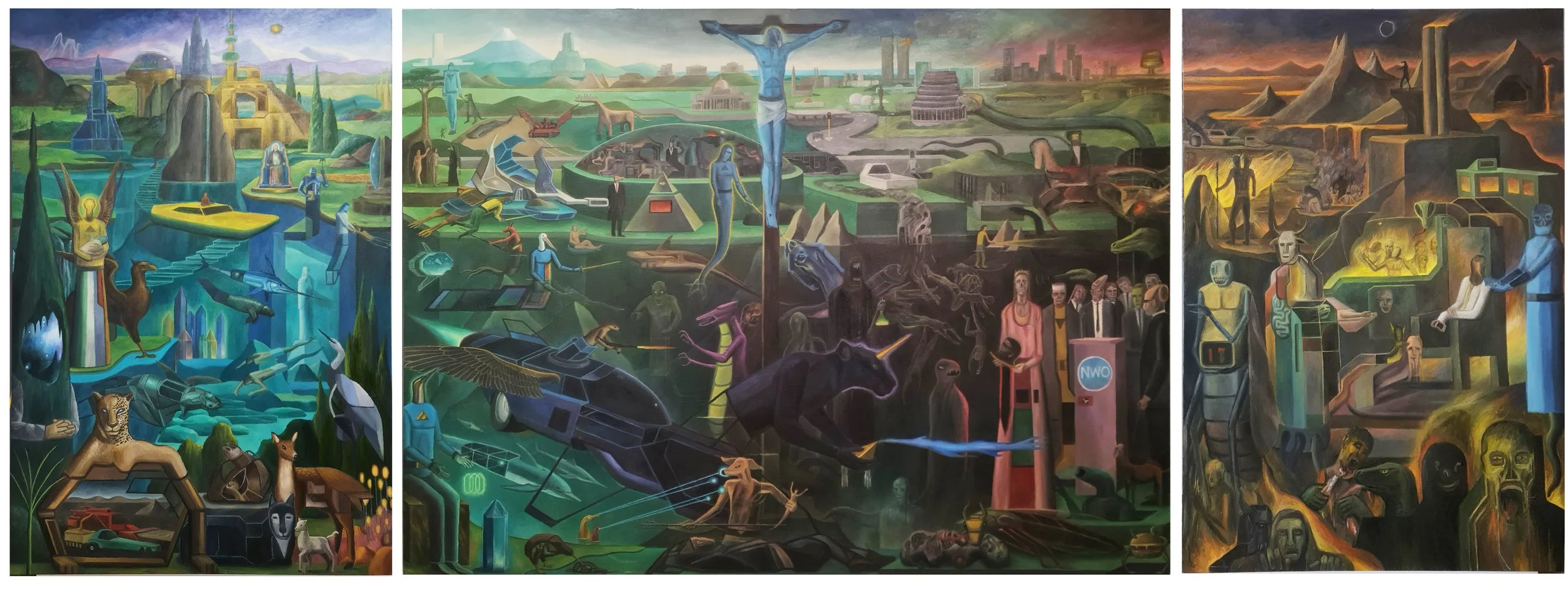
What is true and what is false? What is good and what is evil? The Last Judgement is when the good and the bad, the real and the counterfeit, will be separated out. One lot destined for heaven, and the deceivers for hell. But until that time, as Saint Augustine explains in his magisterial CITY OF GOD (426), the earthly city and the heavenly city (Babylon and Jerusalem respectively) are inextricably mixed. I wonder if Matt’s painting is meant to help bring about the apocalypse? Isn’t it true that at some level we want what we fear? A certain stripe of Christian fears the Last Judgement won’t come fast enough. It is the delay that is the worry, not the promised event itself. Until the Last Judgement happens we are all left wondering if there is any justice in this world. Matt’s bad trip unfolds in stately procession. Potentates and cacodemons are forward-facing and statuesque, as if their stolid stillness demands capitulation and obeisance. Contributing to this sense of inevitability is the repetition of motifs across the canvas, such as towering spacecraft, Medieval towers, Twin Towers and twinned smokestacks, which seen together “uncannily portend the future from the beginning”. At the optic centre of the three panels is the crucified, eagleheaded Christ. Matt has painted a host of messianic avatars in his time. Here, the Son of Man morphs with the majestic griffin of pagan myth, positing Christianity as an open-source religious narrative primed for global scalability. Matt’s Christ is also reminiscent of Bill Hammond’s hierophantic bird figures. In conversation, Matt says that he was thinking about Hammond when he painted his messiah, given that Hammond set a path for the resurrection of figuration in New Zealand art at a time when the orthodox expression of spirituality was abstraction. Despite the serious purpose underlying Matt’s art — “I want to help people see the truth” — he also plays in the garden of art history — “I like making art and painting, yeah!” And this fun shines through his work, both in his bravura putting-of-painton- canvas, as well as the joy — if you are looking for a bit of light relief in the middle of the apocalypse — which I am — of wandering round his world and losing yourself in his metastasising symbolism. It is a revelation.
In this world, I walk into Matt’s studio in Wainuiomata, smack into his latest revelation, EDGE OF ETERNITY. It is three panels — yes, an altarpiece — covering the whole wall. Surely they will have to destroy the building to haul it out of here? The building will be destroyed, that is the whole message I think. In this astonishing work, Matt digs deeper into the symbolism and psychology of THE BOOK OF REVELATION, amplified by his experience and exegesis of Covid times in which he saw demonic conspiracy inflamed by then NZ Prime Minister Jacinda Ardern whose likeness might be seen in the rose-robed Salome in the middle panel — her Beehive in the background — holding what could be Matt Hunt’s own head on a platter. THE BOOK OF REVELATION — author or authors unknown — is scripturally attributed to John of Patmos and dated to the first century AD. Also known as THE APOCALYPSE OF JOHN, it wasn’t included in the Western canon of the NEW TESTAMENT until the Council of Carthage in 397. The Byzantine tradition didn’t accept it as part of their canon until the seventh century. It’s an acid trip, it’s bonkers, it’s a panic-fuelled call to arms. It’s the early Christian community’s psychological correction to Roman persecution and martyrdom.1 In the cosmic drama of Revelation, Christ comes in vindictive power — “out of his mouth went a sharp two-edged sword”.2 It is also a strident denial of the preceding tone and narrative of the NEW TESTAMENT in which God becomes man and actively chooses to die in order to overturn the sectarian warmongering of the TANAKH, establishing instead an universal covenant of atonement, inclusion and peace.3 Originally written in koine or common dialect Greek, the first word of THE BOOK OF REVELATION is apokalypsis. This doesn’t mean catastrophe — although that is what apocalypse has come to signify in English — but revelation. Whether you are a Christian believer of a certain stripe or not, it is indisputable that apocalypse will be spectacularly visible. And visibility is art. At art school Matt did his research paper on Hieronymous Bosch’s the SEVEN DEADLY SINS AND THE LAST FOUR THINGS (c. 1500). In his studio, above the shelves of well-thumbed art books and sci-fi mags, he has a faded print of Hieronymous Bosch’s triptych THE GARDEN OF EARTHLY DELIGHTS (1495—1505). Hand in hand with trash culture, Bosch’s vision is a powerful aphrodisiac for Matt’s enterprise. After all, at the end of time, high and low come together explosively.